Showing posts with label guitar. Show all posts

8.08.2008

Comfort Strapp - the best guitar strap I've found!


These are the coolest and best guitar straps I've been able to find, especially if you play heavy basses or guitars. The two ends are constructed of the typical webbed strap with leather ends, so there's nothing too special about them - it's the middle of the strap that makes all the difference. The middle uses a thick swath of neoprene (the stuff of wetsuits) but its inherent "bounciness" is tempered by its attachment to a fixed-length strap of webbing. So it has a little bounce, but not too much. Having just enough shock absorption makes it comfortable; it makes heavy basses and guitars seem lighter. But by controlling the stretch factor, it doesn't bounce all over the place - your instrument stays where it belongs. The neoprene also has enough friction against most clothes to keep it from sliding; so the Comfort Strapp is the most controlled, best strap I've tried.

Read more about them at Comfortstrapp.com.

Note: I am not a paid endorser of Comfort Strapp.

7.22.2008

The ol' Battle Axe

The bass shown in the photo to the right has been my main axe for almost 12 years now. It's a pretty amazing instrument, with lots of unique features that make it the most gig-worthy and the best-sounding bass I've ever encountered.

My 6-string fretted GTB 356 Model was made by a US-based company called PBC that was located in Coopersburg, PA - they're no longer in business, but the basses are still made by Dave Bunker in Washington State. When I decided that a 6-string bass was going to be a necessity for Second Story, writing partner Scott and I took a trip up to PBC's factory store to check out their basses and manufacturing facility. (We had seen a couple of their basses and even talked to a rep at one of our local music stores.)

When we got there, they had a showroom full of basses - and LOTS of them were sixers. I picked up at least half a dozen while we were there, and they were quite nice; well-appointed, and very nicely finished (most, including my bass, have AAAA-grade flame-maple tops or better.) When I came across the bass I eventually bought, I knew instantly that it was the instrument I had to buy - it practically melted into my fingers. There are some instruments that you just KNOW were made for you, and this bass was one of them. While I was "cashing out" the bass, the guy also confided in me that the bass was originally built specifically for Allen Woody; but when he came to get it, a new model caught his eye and he took one of those instead.

All I know is: the bass is awesome.

Features:
  • Bookmatched AAAA figured Maple top
  • Patented Tension Free neck, 5 piece, Maple fretboard
  • EMG Dual Coil soapbars, EMG BTC Circuit, 18v (The bass came with the pickups; I upgraded it to the BTC preamp and the 18v system)
  • Individual "Through Body" Bridges in Gold plated solid machined Bell Brass (one for each string)


The Tension-free neck is the most interesting special feature on this bass. Rather than a traditional truss rod, the maple neck has a pair of channels routed through it; within these cavities lie two cold-rolled steel bars. All of the tension that the strings impart on the neck assembly are carried by the bars - not the wood. The manufacturers claim that this eliminates dead-spots, and allows for excellent adjustability and durability. All I can say is that the bass plays like buttah, and from the low B on the bottom string to the very highest notes up the C-string the bass has a balanced, even sound - octave to octave, string to string.

The other innovation is the high-mass bridge system; there's actually a separate through-body bridge assembly - made of bell brass - for each string, which ties into the massive tone plate on the back surface of the bass. It makes for a bit of added weight, to be sure - this bass is no lightweight - but it creates the ability for amazing sustain; and since each string has its own bridge, multiple notes played simultaneously ring out and sustain just as well as single notes do. There's just a tremendous amount of clarity and focus to the bass. It... just... sings.

Of course, visually the bass is striking - with its no-headstock design and very beautiful bookmatched top. And the headless design makes for some great ergonomic advantages as well. Firstly, the balance on this bass is amazing - where most six strings "neck-dive" because of the weight of all those tuners on the end of the neck, this bass just "hangs" in playing position with no effort. Also, not having a huge headstock makes the bass a lot more compact, which is valuable on the many crowded stages I've played on - I never accidentally whacked my singer in the head (though I thought about doing it on purpose more than a few times). And it makes for a smaller case, which is nice.

Clearly, I can talk a lot about this bass and go on forever. The maker is relatively unknown, but I'm a big fan and will hang onto this bass forever!

7.20.2008

Funk Fingers?

These are some of my favorite toys. Originally developed by Tony Levin and his bass tech, based on an idea that Peter Gabriel suggested - I believe the story went something like this: When they were rehearsing or recording one of Gabriel's tunes, to get a percussive sound, Tony was whacking his bass with a spare drumstick. Peter said, "Why not attach the sticks to your fingers? The result was this:


For a brief time, Tony actually had a bunch of sets made, and sold them on his website. I was lucky enough to grab a few sets for myself when they were there, since he no longer produces them. As a result, he gives his permission to recreate them yourself for personal use - but mandates that you cannot mass produce or sell them for profit (I think he owns a patent for them). I've since seen original pairs of the ones he produced sell on eBay for over $100 (which is ridiculous since they should be easy enough to make for yourself.)

I actually got pretty good at using them; I performed with them regularly in live concerts and bar gigs with Second Story - as well as recorded two of the songs for the second album using them ("Dancing on the Hill" and "Abducted"). I hope to soon have some video available of them in action.

But they're neat, very cool, and they never failed to get a reaction from the crowd when I started smacking my bass with them. And they can provide an ultra-percussive bass sound that just can't be matched with the thumb alone.

Here's a clip from the studio (pre-vocals) of "Dancing on the Hill," which features me playing the Funk Fingers through a distorted amp.

And here's a sound clip, from a live performance with Second Story

Ahhh... toys.

7.18.2008

The FrankenStrat (part II)

(continued from yesterday's post)
The Electronics
So, now that I had the beginnings of a cool guitar, I needed to outfit it with some pickups. I knew that a red tortoiseshell pickguard would look super cool against the pale yellow body, so I ordered a loaded pickguard from Carvin. The pickups actually sound really good, with a vintage vibe but not a lot of noise. They're three single coils, classic Strat-style. However, they also add a special "7-way" switch to allow you to add the neck pickup to any other pickup combination; so, in addition to the typical five-way switching of a standard Strat, you also can flip the switch to get the previously unattainable neck and bridge combination, as well as all three pickups simultaneously.

Another thing trashpicked at GVOX was an old Fishman Strat-style bridge with piezo elements mounted in the saddles. Each of the tiny wires for the piezos had been severed, presumably for testing with pitch-to-midi systems, so I had to carefully re-attach them and wire it up as best I could. Once I did that, I got an active blending preamplifier from Bartolini to blend the piezo-electric elements with the magnetic pickups. I moved the "7-way" switch on the pickguard and installed the blend knob inline with the other two pickup knobs (vol/tone), and drilled tiny holes in the pickguard to allow access to the gain micro-pots for each pickup channel.

So electronically, the FrankenStrat exceeds the capabilities of most other Strats; allowing for 7-way pickup selection, "acoustic-like" piezo pickups in the bridge, an active blending preamp... it's pretty awesome sounding.

The Final Touches
All that was left were some final touches. I got a custom matching (well, almost) back plate cover made, put Grover locking tuning machines into it, and most recently, got a custom neck plate with a holographic laser-etched "Custom Shop" logo design on it. I sanded most of the finish off the back of the neck and protected it with Boiled Linseed Oil, which is one of my favorite techniques for a really comfortable and fast neck. Finally, I took it to a trusted guitar tech and had him fully set it up for action and intonation.

While I'm not a great guitarist (I'm far better on bass) this guitar is like "going home" for me. It's a little heavy, thanks to the Squier body, but it balances really well on a strap or on my knee. Perhaps it's the special time and effort I put into it, but it just feels like "my" guitar and no one else's. I'll never get rid of it. If you've never dabbled with putting a guitar together with parts, no matter where the source, I highly recommend it. It's a very rewarding experience!

7.17.2008

The FrankenStrat

Here she is, my favorite electric guitar. It's a true FrankenStrat, and over the years I've put a lot of work into it and I'm quite happy with the results.

Humble Origins
The guitar got its start when I worked for a music software company. Among the products offered by GVOX was a computer interface for guitar; it allowed you to connect the guitar to your computer and use it for learning and composition. Nowadays, guitar-to-MIDI systems by Axon, Roland and Yamaha surpass (by far) the capability of the GVOX Guitar System, but at the time, they were cheap and pretty effective.

Over the years, they'd acquired a fair number of guitars at GVOX, for testing, giveaway prizes, etc. They had even forged a special relationship with Fender at one point to market and sell a "GVOX-Ready Strat" which had the mounting hardware for the GVOX pickup built in. So there were a lot of guitars around the office. I even had a pretty cool Strat next to my desk. That said, some of the technical gurus had even, at one point, apparently been working on wired-fret guitar systems and other such tech toys - so a lot of the guitars around the building had been somewhat "abused."

One such instrument provided me with the body for my favorite guitar. One day, while helping to take out the trash, I noted that a Squier Strat was being sent to the dumpster; its electronics gutted, its neck de-fretted and cracked... but the body, a cool yellowed semi-transparent, was in really good shape! So the body (with permission, of course) ended up in my back seat instead of the dumpster.

Similarly, some months later, I was helping to clean out our basement storage area and a Mexican strat whose body had been heavily battle scarred (but whose maple neck looked to be almost perfect) was marked for disposal but found its way to my house. A little bit of Dremel work later, the neck fit securely into the pocket, and I had the beginnings of a rippin' Strat!

(to be continued tomorrow)

7.11.2008

HOW many strings are on that thing?


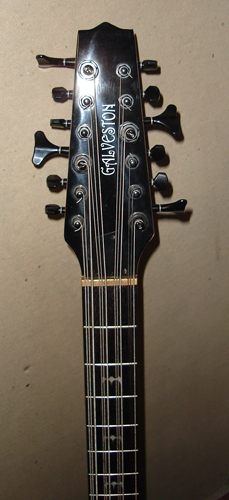
If you really want to get the audience's attention, you pull out a bass like this one. It's a 12 string bass (yes, you read that correctly.) It is actually sort of like a combination of a 4-string bass and a 12-string guitar; the strings are tuned in groups. There are four "root" strings for the standard bass guitar pitches of E-A-D-G. Then a pair of matching strings tuned one octave up are placed in close proximity to the main strings. So what you end up with, in the case of my instrument, is a tuning as follows (where a capital letter indicates the root string and lowercase letters are the octaves):

eeE aaA ddD ggG


The groups of strings are called "courses" and they are fretted and strummed/plucked in groups of three. What results is a HUGE, ringing, naturally chorused sound that can just fill the room.

Here's a clip from the second album from Second Story - a bit of "Truth Is..." which features the 12-string.

You've probably heard a 12-string before - Jeff Ament used one for the intro and outro riff (and much of the song) in "Jeremy"; playing a repeating figure complete with octaved harmonics. It's the signature line on the song. Another popular user of the 12-string is Doug (dUg) Pinnick of King's X; he's used it a number of times over the years, and since King's X is a trio, having the extra "girth" that a 12-string provides comes in handy, I'm sure.

As for me, I used it in two Second Story songs - "Truth Is..." and "Wise" - it also makes a brief appearance in the Din Within song "The Bottom/Between Two Lives." And I intend to use it a good bit more on the next Din Within album.

My particular bass is made by "Galveston," which is one of several names slapped on instruments that come to the States from China under several brand names (including several store brands). While the bass is quite solid, the stock electronics sucked big time, so I replaced them with some Seymour Duncan actives and a Bart preamp - the new pickups really emphasize the "chimey-ness" of the octaves, and yet they really helped to fill out the bottom end, too. And the Bart preamp really gives the bass a lot more headroom, which is necessary for a bass that creates so much bandwidth. Altogether, quite a worthwhile upgrade, even though I had to do a little work with the Dremel to make it happen.

It's not for everybody (or every song, to be sure) but the 12-string is a pretty awesome tool to have in your arsenal. I'm sure it intimidates most of the guitarists I know!

7.05.2008

My Introduction to Circuit Bending

So, if you've never come across the term, "Circuit Bending" is a sort of underground craze. Basically, it's creatively short-circuiting otherwise perfectly good electronic equipment, with the goal of creating new, sometimes strange, often other-worldly sounds with it. A very commonly "bent" device is the classic "Speak and Spell" toy (and its variants, like the "Speak and Math", etc.) - when you open one up and bridge certain points on the circuit board, you can speed up, slow down, pitch-shift, and otherwise mangle the voices that it creates, often to quite interesting and spooky effect.

So... why the heck would you do this? Well, a lot of "noise-based," soundscape and other "aliatory" music-makers think of these sort of sound makers as a goldmine for creating unusual sonic surprises in their music. And, if you're into experimenting and creating something new, it's really kind of fun! Plus, you can buy loads of "toys" to "break" on a pretty low budget.

DISCLAIMER: If you try any of this yourself, please limit yourself to BATTERY-POWERED devices only. Short-circuiting the wrong points on AC-powered electronic devices can KILL you.

So, my first project, seen above and below, was a practical one for me, since I'm a more conventional player rather than a soundscape artist. I picked up a lightly used Boss DS-1 Distortion pedal for $30, opened her up, and starting playing with different connections on the circuit board. I found several points of interest (thanks to some help on the web of those who've bent this pedal themselves) and thereby made a common distortion pedal into something unique and interesting.

You can see the switches and buttons I installed into the sides of the pedal; they activate the short-circuits (and, of course, turn them off for normal use). Another way to modify circuits(rather than a simple on/off switch) includes using potentiometers to vary the amount of current flowing to the short, which thereby varies the alteration. Even more interesting, some folks use light-sensing variable resistors; by changing the amount of light entering the light sensor, it changes the sound - cool! Body contacts, to allow your touch to modify the short, is another method commonly used. For my first project, though, I thought it prudent to keep it simple, so I stuck to switches.

So there are four different mods, which are turned on and off using the metal switches. I then further modified two of them with the red buttons; by pushing in the button, it puts a tone cap inline in the short-circuit, which modifies the pitch that is added/generated by the short-circuit. Playing with the existing knobs also modifies the bend.

All in all, I just wanted to get into circuit bending with a minimum of difficulty and a high level of success (meaning: I didn't want to "kill" the pedal, and wanted to have something I could actually use when I finished.) I did exactly that; I now have a "new" pedal which can make unique and unusual (but useful) sounds, and I did it myself for under $50.

It's cool stuff!